TikTok Hooks That Sell Products: 30 Templates From Viral Posts
We broke down the opening hook of 141 viral TikTok and Instagram posts. Half used a curiosity gap. Here are 30 fill-in-the-blank hook templates for product brands, each taken from a real post with its view count.
 Moss5 min read
A TikTok hook is the first line and first frame of a post: the part that decides whether someone stops scrolling. The hooks that work best for products open a question the post answers, most often with a curiosity gap ("things I wish I knew before buying…"), a relatable problem, or a warning. In our breakdown of 141 viral posts, 49% opened with a curiosity gap, 14% with a relatable pain and 10% with a warning.
Key takeaways
- Curiosity gaps dominate: about half of the viral posts we analysed opened with one.
- The best hooks name a specific audience or problem ("oily skin", "first time mom", "small creators").
- Numbers make a promise concrete: "3 mistakes", "8 steps", "20 small ideas".
- The product rarely leads the hook. It shows up as the answer, not the headline.
- Use the 30 templates below by swapping in your product, problem and audience.
How we found these hooks
Mostly Discover breaks down viral posts from brands and creators: the hook, the format, why it worked and how to remake it. For this guide we pulled the 141 organic posts that have a full breakdown and grouped their opening hooks by type.
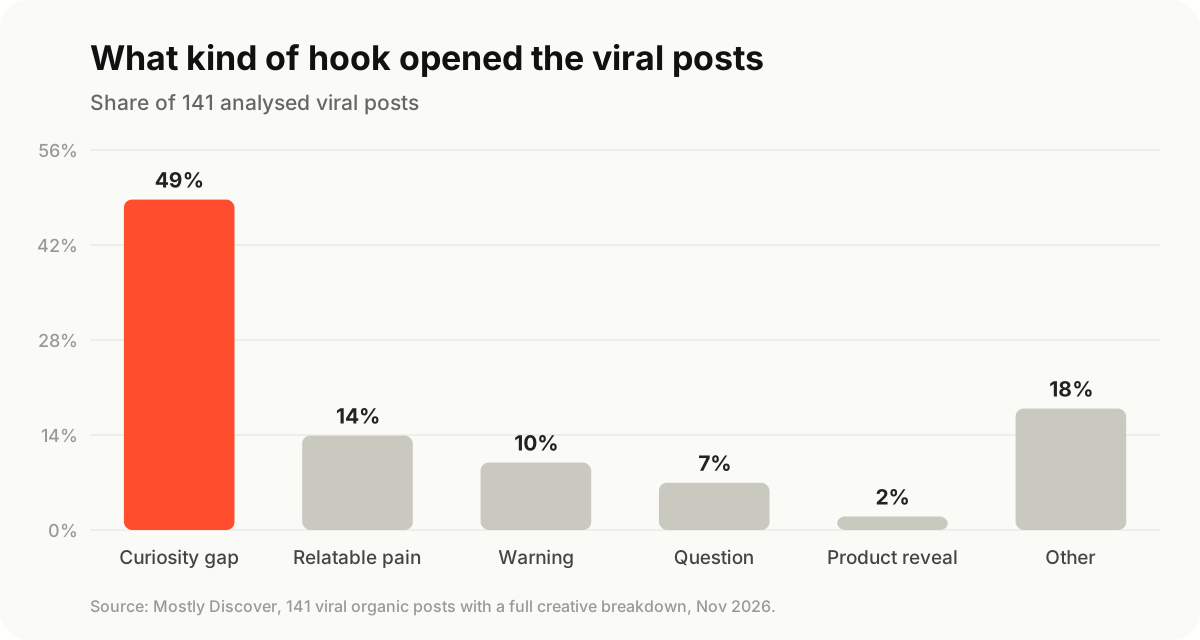
| Hook type | Share of viral posts | What it does |
|---|---|---|
| Curiosity gap | 49% | Promises information and holds it back until the swipe or the end |
| Relatable pain | 14% | Names a problem the viewer has right now |
| Negative warning | 10% | "Don't make this mistake": fear of getting it wrong |
| Direct question | 7% | Asks something the viewer wants to answer or know |
| Visual product reveal | 2% | Lets the product itself stop the scroll |
| Other | 18% | Social proof, before/after, POV, stats, contrast |
These posts are the ones that went viral, so this shows what winners did, not what all posts do. Still, the pattern is strong: the hook is almost never "Introducing our new product".
30 TikTok hook templates (with the real posts behind them)
Fill in the {brackets} with your own product, audience and problem.
Curiosity gap hooks
- "Things I wish I knew before buying {product}" (from "Things I wish I knew as a first time mom", 23M views)
- "I turn {age} this year, here's what I wish I knew about {topic} at {younger age}" (23.7M views)
- "I was today years old when I found out {unexpected use for your product}" (9.8M views)
- "If you take 1 tbsp {ingredient}…" (iced-coffee recipe carousel, 6.9M views)
- "{Number} things I wish I knew before {buying / starting / trying} {category}" (6.9M views)
- "My {product category} favorites ⭐" (skincare shelf carousel, 5.5M views)
- "A {group}'s {personal collection} is the most interesting thing in the world" (notes-app carousel, 7.6M views)
- "Let's pack a {size} order" (small-business packing video, 21.8M views)
- "{Customer} spent {amount} and got {quantity} {product}!!" (jewelry brand, 2.4M views)
- "Ranking {category} (from a {credential})" (coffee ranking by a chef, 2.2M views)
Relatable pain hooks
- "The {occasion} {product} every {audience} needs (no {pain point} required)" ("The travel sneakers every girl needs (no break-in required)", 1.1M views)
- "My {time of day} routine" (morning coffee routine, 1.3M views)
- "When I open my {app} to find {thing} but instead find {surprise}" (notes-app carousel, 9.3M views)
- "Update on the {product} after {time} in {situation}" ("update on the NB 237s after 12 days in Japan & 20k steps a day", 1.4M views)
- "{Category} for {skin type / body type / use case} ✨" ("Facial routine for oily skin", 2.2M views)
Warning hooks
- "Common mistakes I see {audience} make with {product category}…" (17.6M views)
- "ALWAYS read the {product} reviews!!!! 🤢" (wallet video, 2.2M views)
- "{Situation}? Never make these {number} mistakes" ("LIVING ALONE? NEVER MAKE THESE 5 MISTAKES", 3.2M views)
- "Top 3 mistakes we see {customers} make with {task}" (driving school carousel, 3.6M views)
- "Reason #1 why I hate {competitor or old way} 😭" (app review, 1.8M views)
Question hooks
- "Why you're {symptom or problem} so much & how to stop" (gut-health carousel, 10M views)
- "What's one cheap purchase that made your life WAY better?" (4.6M views; works great as a comment magnet)
- "What's something you added to your routine that got rid of {problem}?" (4.5M views)
- "{Occasion} gift idea" ("Birthday gift idea", 3.6M views)
Routine and list hooks
- "CORRECT {routine} in {number} steps" (body care carousel, 2.3M views)
- "My top 3 {category} I've tried and genuinely love 💗" (1.1M views)
- "Now it's time for my PM routine" (skincare video, 3.2M views)
- "{Things} that actually {specific benefit}" ("Foods that actually repair your gut lining", 1.9M views)
- "COOL STUFF FOR YOUR {room}, part 1" (room-finds carousel, 2.5M views)
- "{Brand} {product} taste test" (Liquid Death energy drink taste test, 3.2M views)
How to turn a template into a hook for your product
Take template 16 and a skincare brand selling a vitamin C serum:
- Template: "Common mistakes I see {audience} make with {product category}…"
- Filled in: "Common mistakes I see people make with vitamin C serum…"
- Slides or beats: applying it at night, storing it in the bathroom window, layering it with the wrong products, then "how I use mine" with the serum in shot.
- Caption: "Send this to someone who keeps buying vitamin C and seeing nothing 😭" (see our guide to TikTok captions that sell).
The product appears as the answer, which is why it doesn't feel like an ad.
What makes a TikTok hook work
- A specific audience. "Small creators", "first time moms", "oily skin". People stop for posts that are obviously about them.
- An open loop. The hook promises something the post delivers later, so the viewer stays to close the loop.
- A number. "3 mistakes" tells the viewer exactly what they're signing up for.
- Text and visual agree. The on-screen text and the first frame say the same thing. A strong line over a confusing image loses people.
- It's said in the first second. Put the hook as on-screen text in frame one; don't wait for the voiceover to get to it.
A hook is the first of three tests a post has to win; see how to go viral on TikTok as a product brand for the other two.
FAQ
What is a hook on TikTok?
The opening line and first frame of a post: the on-screen text, the first spoken words and the first image. It decides whether someone keeps watching or scrolls past, usually within one to two seconds.
What is the best hook for a TikTok product video?
In our breakdown of viral posts, curiosity-gap hooks were the most common by far (49%). For products, "Things I wish I knew before buying {product}" and "Common mistakes people make with {product}" are reliable starting points.
How long should a TikTok hook be?
Short enough to read in about two seconds: roughly 4–10 words on screen. Long hooks get scrolled past before they're read.
Should the hook mention my product?
Usually not first. Most viral product posts lead with the problem or the promise and show the product as the answer. Lead with the product only when the product itself is visually surprising.
Where can I find hooks that are working right now?
Watch what's getting outsized views in your niche, not just what's popular overall. Mostly Discover flags posts that beat their account's usual views and breaks down the hook, so you can remake the format for your product. The same applies to ads; see our Meta Ad Library guide.