Static Ads That Keep Running: What 520 E-commerce Image Ads on Meta Show (2026)
We sorted 520 image ads from 35 e-commerce brands by format and angle, then checked which ones were still running a month later. Before/afters and feature callouts lasted. Discount banners mostly didn't.
 Moss7 min read
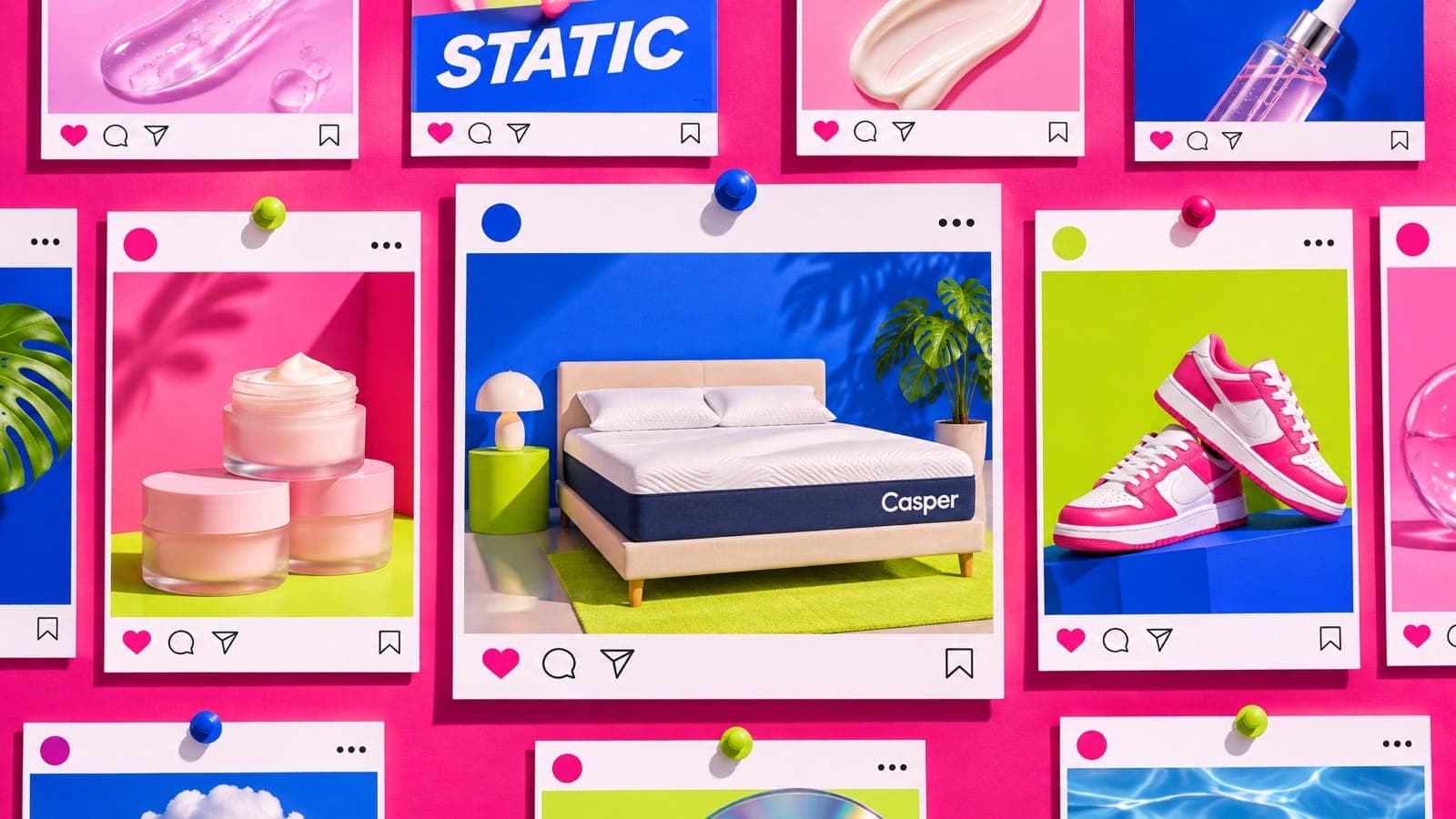
A static ad is a single image ad, with no video or motion, usually a product photo with a headline. On Meta in 2026 they still pull their weight. Among 520 image ads from 35 e-commerce brands, before/after and feature-callout ads kept running the longest. Discount banners rarely lasted, so lead with the problem your product solves rather than the price.
Key takeaways
- 26% of the e-commerce image ads we tracked became "proven", meaning they ran 30+ days, or 14+ days with 3 or more versions. Brands switch off ads that don't pay, so longevity is the best public signal of a winner.
- Before/after (8 of 10) and feature callouts (15 of 31) were the formats most likely to keep running.
- Ads with a discount or offer in the image became proven only 9% of the time, against 31% for ads without one.
- Angles that name a problem or teach something lasted longest (47% proven). Price-led angles lasted least (11%).
- Almost every static ad that lasted had text on the image (129 of 133).
Our data
We used the Meta ads tracked in Mostly Discover. For this post we took every single-image ad from product brands (apparel, D2C e-commerce, skincare, health and fitness, food and drink) and left out software and other non-product advertisers. That gave 520 image ads from 35 brands, all running in 2026, including Casper, Purple, Huel, HUM Nutrition, Topicals, Boll & Branch, Vuori, True Classic and Poppi.
Each ad was tagged by format (studio shot, model shot, before/after and so on), angle (the reason to buy it leads with), whether it showed an offer, a person or text, and how it looked. Then we checked how many of each kind became proven, the label Discover uses for ads that ran 30+ days, or 14+ days with 3+ variations.
Two warnings before the numbers. Some groups are small (10 before/after ads, from 7 brands), so treat them as strong hints rather than laws. And "proven" measures how long a brand kept paying for an ad, not its exact return. We also checked an older, smaller sample (42 image ads from 25 brands). It pointed the same way on the two biggest findings, before/afters and offers, but it's too small to stand on its own.
Which static ad formats last longest on Meta?
Before/afters and feature callouts were the most likely to last. The plain studio shot, the most common static ad of all, became proven only 21% of the time.
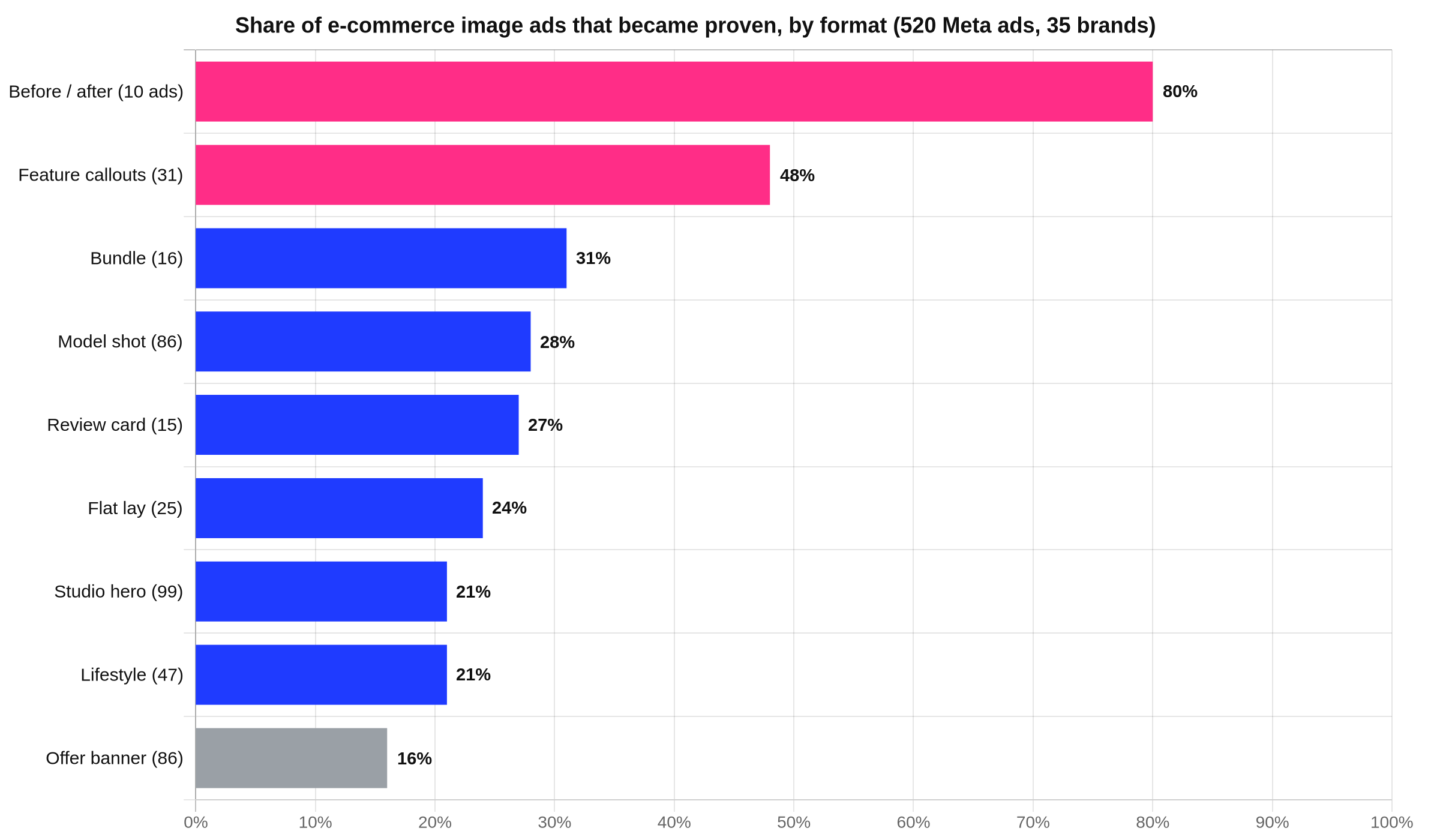
| Format | What it looks like | Ads | Proven |
|---|---|---|---|
| Before / after | Split image: the problem, then the result | 10 | 80% |
| Feature callouts | Product in the middle, 3–5 labelled benefits around it | 31 | 48% |
| Bundle | Several products together, often with a set price | 16 | 31% |
| Model shot | Someone wearing or holding the product | 86 | 28% |
| Review card | A customer quote over or beside the product | 15 | 27% |
| Flat lay | Product and props from above | 25 | 24% |
| Studio hero | Product alone on a clean background | 99 | 21% |
| Lifestyle | Product in a real setting | 47 | 21% |
| Offer banner | Product with a big "X% off" or "sale" banner | 86 | 16% |
Two formats never lasted in this sample: stat headlines (0 of 8) and memes (0 of 5).
What do long-running static ads look like?
Here are real headlines from ads that ran for weeks or months, by format. These are the ads worth copying the structure of, not the words.
Before / after
- Poppi: "Old Me" (47 days, three versions).
- Lovevery: "12+ weeks of EASY TUMMY TIME" (86 days).
- The Ordinary: "See Immediate Results. Get Long-term Visible Repair." (38 days).
- Ruggable: "ONE RUG… THAT'S ALL IT TAKES." (39 days).
Feature callouts
- Casper: "Why 4 out of 5 sleepers recommend Casper" (139 days).
- Topicals: "Depuff and brighten dark circles" (91 days).
- HUM Nutrition: "WHAT IS GLP-1?" (99 days), an education ad set up as callouts.
- Huel: "A week of breakfast for less than £20" (216 days, the longest-running ad in the set).
Other formats that lasted
- Topicals review card: "My dark spot vanished overnight." (134 days).
- HUM Nutrition reverse psychology: "DON'T BUY THIS SUPPLEMENT..." (78 days).
- Mack Weldon model shot: "LOOKS LIKE A BLAZER. FEELS LIKE A SWEATSHIRT." (75 days).
- Our Place problem/solution: "Perfect Rice, Every Time" (31 days).
Notice the Huel ad. It's about price, but it doesn't show a discount. It turns the price into a value per use, "a week of breakfast", and puts it in a callout layout. That's very different from a banner that says "20% off".
Do discount ads work as static ads?
They run, but they don't run long. 121 of the 520 ads put an offer in the image, and only 11 of them became proven (9%). Ads without an offer became proven 31% of the time. Sorted by angle, the pattern is the same: price-led ads were the second most common angle (107 ads) and among the least likely to last (11%).
That fits how brands use them. Sales are short by design, so a Black Friday banner is meant to stop when the sale stops. Our earlier look at the full 1,716-ad library found the same thing: discount-led ads were much rarer among long-runners (11% vs 29%). The lesson for a small brand is about your always-on ads. Keep discounts for sale windows, and make your evergreen static ads about the problem and the product.
Which angles last longest?
Problem-led and education angles lasted longest. Identity ("for busy moms") and curiosity angles lasted least.
| Angle | What it leads with | Ads | Proven |
|---|---|---|---|
| Problem / pain | The thing that's wrong ("dark circles", "back pain") | 34 | 47% |
| Education | Teaches something ("What is GLP-1?") | 17 | 47% |
| Novelty / product | What's new or different about the product | 135 | 37% |
| Aspiration | The life or look the buyer wants | 62 | 27% |
| Urgency | "Back in stock", "almost sold out" | 19 | 26% |
| Social proof | Reviews, ratings, "4 out of 5" | 43 | 23% |
| Authority | Doctors, science, awards | 24 | 21% |
| Curiosity / story | A teaser or a story opener | 35 | 14% |
| Identity / audience | Who it's for | 44 | 11% |
| Price / offer | The deal | 107 | 11% |
Curiosity is the surprise here. On organic TikTok, curiosity-gap openers were the most common hook among breakout posts (see our TikTok hooks that sell). In a static ad there is no second frame to pay the curiosity off, so the ad has to say what the product does right away.
Should a static ad have text on it?
Yes. 492 of the 520 ads had text on the image, and 129 of the 133 proven ads did. The few text-free ads lasted less often (4 of 28). A static ad has one frame to say what the product does, so the headline does most of the work.
Two smaller findings, worth testing rather than trusting:
- Showing a person didn't help on average (22% proven with a person, 28% without). Model shots did fine for apparel, but many product ads worked without anyone in them.
- Casual looks lasted more often than polished ones. UGC-style images (7 of 17) and AI-rendered scenes (12 of 30) became proven more often than pro photos (25%) or designed graphics (23%). The groups are small, so take this as a reason to test a casual version, not a rule.
How to make static ads that last (a checklist)
- Pick one problem your product fixes, in the words a customer uses.
- Choose a format that shows the fix: before/after if the change is visible, feature callouts if the product does several things.
- Write the headline first. One line, under ten words, that names the problem or the result.
- Use a real product photo as the base so packaging and labels are right. Our product photography ideas cover the shots that work as ad bases.
- Leave the discount off your always-on ads. Run offer banners only during sales.
- Make 3 versions (different headline or background) and give them two weeks. If one is still worth paying for after 30 days, it's your control ad.
You can check which of your competitors' image ads have lasted with the free Meta Ad Library: look at the start date on each ad. Mostly can lay out a product photo as a before/after, feature-callout or review-card ad from your brand kit, so you can test all three in an afternoon.
FAQ
What are static ads?
Static ads are single-image ads with no video or animation. On Meta they're the "single image" format. They usually combine a product photo with a headline, and sometimes a short benefit list, a review or an offer.
Do static ads still work on Facebook and Instagram in 2026?
Yes. In our sample of Meta ads, image ads made up 43% of the ads that became proven, close to their share of all ads, so they last about as often as video. They're also faster and cheaper to make and test.
What is the best static ad format for e-commerce?
In our data, before/after (8 of 10 proven) and feature callouts (15 of 31) lasted longest. The best choice depends on the product: use before/after when the result is visible, callouts when the product has several benefits.
What size should a static ad be on Meta?
Use 1080×1350 (4:5) for Feed and 1080×1920 (9:16) for Stories and Reels. On 9:16 images, keep the headline and product away from the top and bottom edges, where Meta puts its own buttons and captions.
How many static ads should I test at once?
Start with 3 to 5 versions of one idea, changing one thing at a time (headline, format or background). Give them about two weeks, then keep the ones still worth paying for.
Are discount ads bad?
No, but they're short-lived by design. In our data, image ads showing an offer became proven 9% of the time against 31% without one. Use them for sales and keep your always-on ads about the product.
Want static ads for your own products without a designer? Start free with Mostly.